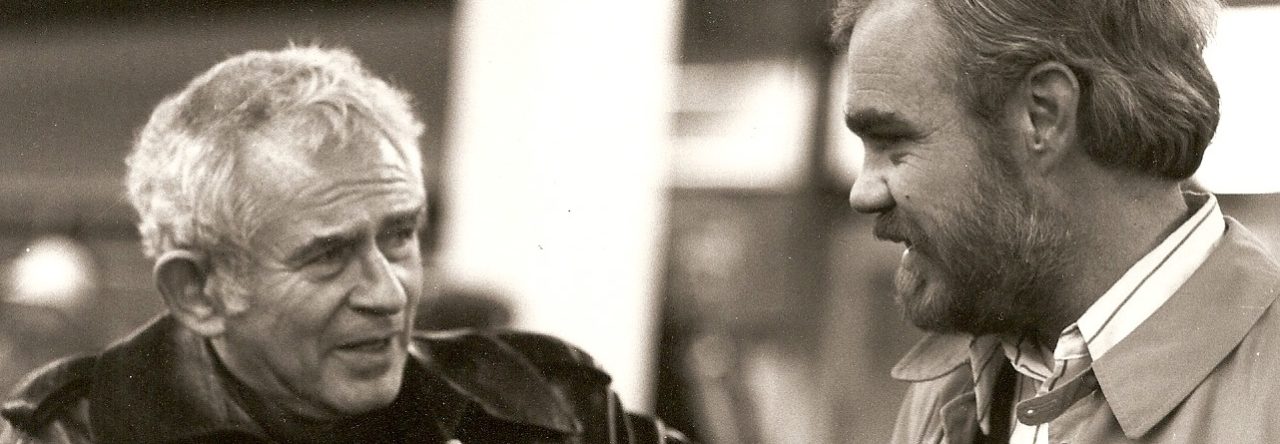
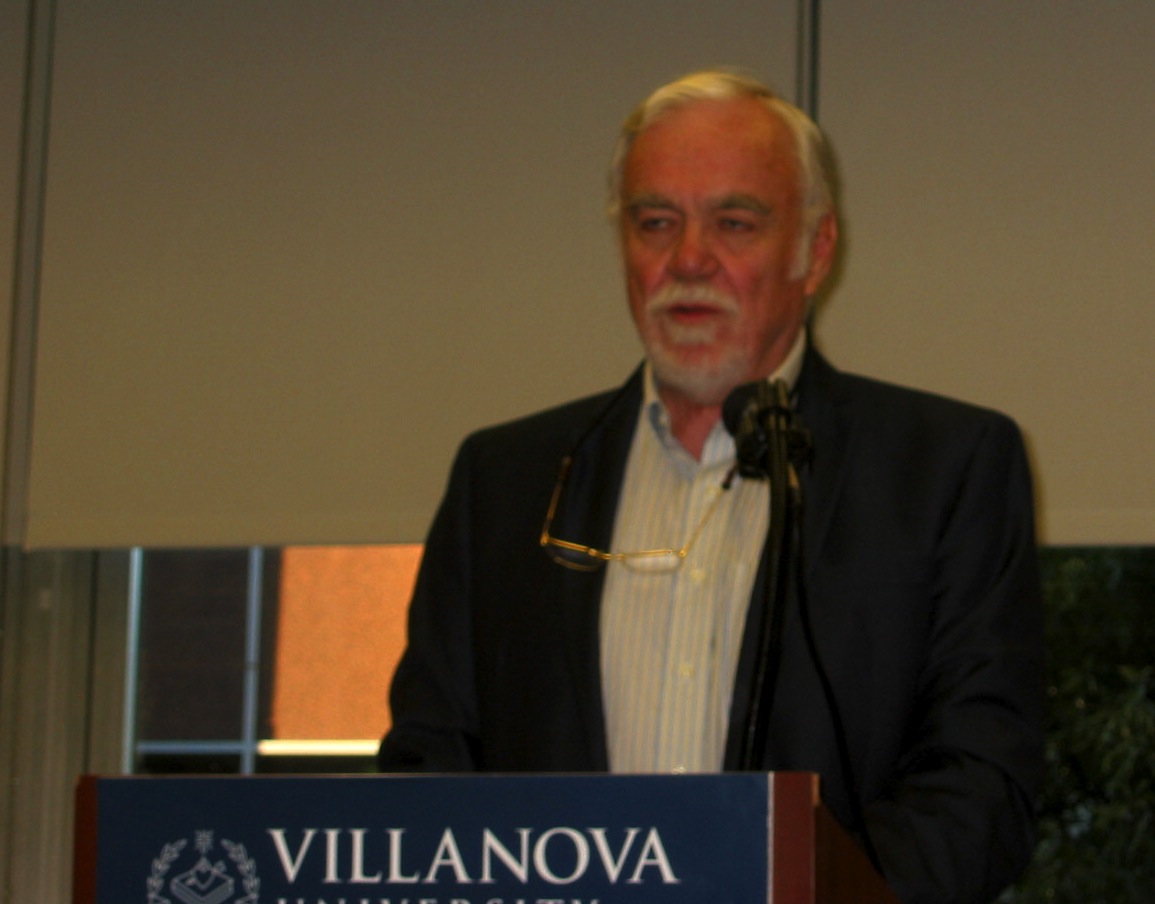
On Tuesday, Sept. 17, Norman Mailer’s official biographer, J. Michael Lennon commenced the first in a series of lectures as a part of the hybrid Irish and Africana cultural studies program. J.M. Lennon is an emeritus professor of English at Wilkes University, as well as the father of University professor Joseph Lennon, who is also the head of the Irish Studies program.
An excerpt from a review of The Executioner’s Song in the Springfield State Journal-Register, November 1979
Routinely, at Gary Gilmore’s autopsy, the doctors peeled the skin back from his face as if it were a rubber mask, sawed open his skull, removed and weighed his brain. Then looking for tumors and motor system difficulties, they sliced it up as one would a meat loaf. They found nothing remarkable. Nor did they discover any abnormalities when examining the rest of his body, including his heart, or what was left of it.
In an attempt to delineate the character of Gilmore, Norman Mailer has written a 1,000-page “true life novel,” from his release from the U. S. Penitentiary at Marion, Illinois in April 1976 to the moment nine months later when his heart was pulverized by four steel-jacketed bullets in a deserted building at Utah State Prison.
Gilmore’s cold-blooded murders of a hotel operator and a gas station attendant, his capture, trial, conviction and sentencing were given full, if routine, coverage by the Utah media. But Gilmore did not receive national attention until he fired his court-appointed defenders, waived his appeal, and demanded that his death sentence be carried out on the appointed day. Presuming a hidden motive, the Utah Attorney General, and the media, expected an eleventh-hour turnaround by Gilmore, one that would no doubt be strengthened by his fierce insistence that he be executed. It didn’t happen. Gilmore was (excuse this) dead serious.
Not since the Rosenbergs’ execution in 1953 had a capital case received such attention. Gilmore’s face appeared on the cover of Newsweek, and on T-shirts (one of which, Gilmore said with gallows humor, might be worn to the execution and then auctioned off); the wire services systematically interviewed his friends, relatives, and lawyers; his tortured love affair and suicide pact with Nicole Baker made the evening news on TV. Even his selection for the condemned man’s last meal—a six-pack of Coors—commanded the front page of major metro newspapers. Through it all, Gilmore limited his contacts with the media, having signed an exclusive access contract with Lawrence Schiller, literary entrepreneur and Mailer’s collaborator. But his refusal to talk with the press only heightened his notoriety. Gary Gilmore became a household word in America before he died.
DID YOU KNOW? Mailer’s largest live audience was approximately 10,000. On May 21, 1965, he spoke at a Teach-in at the University of California, Berkeley, which was organized by Jerry Rubin and others. He began his speech by noting that the citizenry’s “buried unvoiced faith that the nature of America” had over the past months “taken a pistol whipping.” The cause: the most advanced nation in the world was “shedding the blood and burning the flesh of Asian peasants it has never seen.” This was being done, officially, to keep the nations of the Far East from falling under the Communist yoke. The Communists could only flounder in the nations they conquered, he argued. The real reason for the Vietnam War, he continued, was that the president needed to get the country’s mind off the civil rights movement at home. His fear, he said, is that President Johnson, this “bully with an Air Force,” was “close to insanity” brought on by “his need for action.” He ended his one-hour speech by urging everyone to attach photos and drawings of Johnson’s face, on every surface, on walls and phone booths and billboards. “You, Lyndon Johnson, will see those pictures everywhere upside down, four inches high and forty feet high; you, Lyndon Baines Johnson, will be coming up for air everywhere upside down. Everywhere, upside down. Everywhere. Everywhere.”
Mailer’s speech was broadcast live on radio station KPFA. Later, portions of the speeches of Mailer and several others who spoke at the teach-in—including Dick Gregory, Mario Savio, Dr. Spock, and Senator Ernest Gruening of Alaska—were transferred to two LP records and issued by Folkways (No. 5765). Mailer wrote to a friend after the teach-in and said that for the first time in his life he had received “a standing ovation which went on for many minutes.” It was most welcome, he said, because that at this stage of his career he was caught between “counter-waves,” of approval and disapproval, and “I am being bounced like a cork at the confluence.”
DID YOU KNOW? Asked to name his favorite word by the New York Times, Mailer said: “Improvisational.”