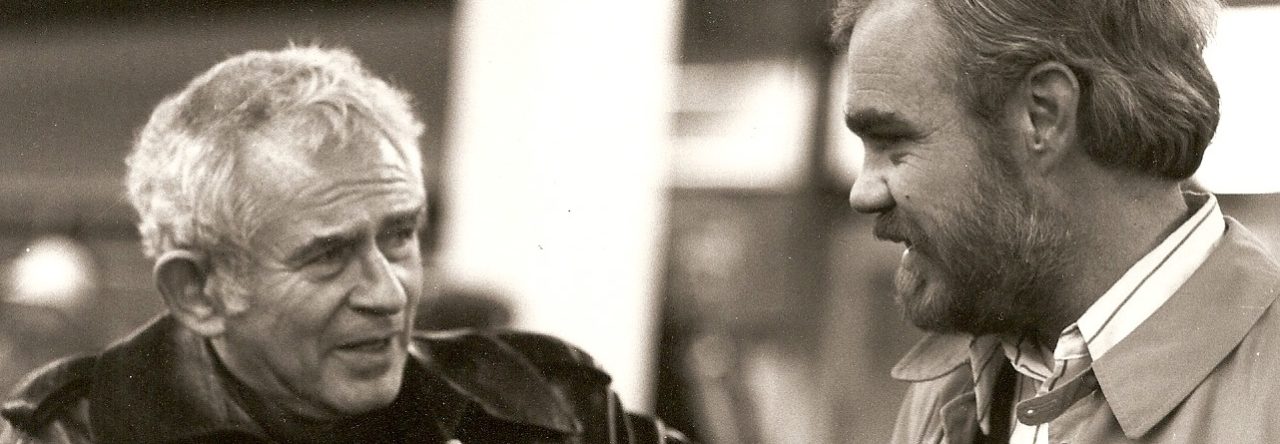
J. Michael Lennon, who is at work on an authorized biography of Norman Mailer, speaks with Sasha Weiss about Mailer’s letters and what they reveal about his ambitions, his relationships with other writers, and his enduring obsessions.
Edited by J. Michael Lennon.
Norman Mailer was the most famous writer of his generation. People who never read a word that he wrote knew who he was, whether because of his fame as a novelist or journalist, or his notoriety because of his many marriages and affairs, his rivalries with other writers (Gore Vidal, especially), his appearances on television, his campaign for mayor of New York City, his prominence as the leading public intellectual of his time.
J. Michael Lennon was authorized by Mailer and the Mailer estate to write his biography, and as such, had access to family and friends, and to unpublished documents, notably Mailer’s letters (Lennon has edited the letters for publication by Random House, Mailer’s longtime publisher). He has interviewed more than 80 people for this biography, but most important of all, he knew Mailer for decades before the latter’s death in 2007.
Norman Mailer: A Double Life reflects Mailer’s dual identities: journalist and activist, devoted family man and notorious philanderer, intellectual and fighter, writer and public figure. Mailer himself said he had two sides “and the observer is paramount.” Readers of Lennon’s biography may find this self-assessment to be debatable.
Mailer was a two-time Pulitzer Prize winner (The Armies of the Night and The Executioner’s Song). His first book, The Naked and the Dead, was an enormous best-seller, and Mailer would have ten more bestsellers, both fiction and non-fiction. He knew many of the most famous writers of his generation — Capote, Didion, Styron, James Jones, Lillian Hellman, Bellow, Vidal, Tom Wolfe — and quarreled with several of them. He was married six times, had nine children, and had numerous affairs. He stabbed his second wife, and later championed a convict writer (Jack Henry Abbot) who, on his release from prison, stabbed an innocent man to death. Mailer co-founded The Village Voice and wrote a column for that paper in the late 1950s. He ran for mayor of New York City in 1969 (with Jimmy Breslin as his running mate), a campaign that was as entertaining as it was quixotic. He was a prominent opponent of the War in Vietnam, and bete noire of the women’s movement. He was one of the leading voices of the New Journalism of the 1960s. He obsessed about the Kennedy assassination and the suicides of Marilyn Monroe and Ernest Hemingway, and wrote often about all three of these iconic figures. He was perhaps the most provocative chronicler of the second half of the twentieth century, both as journalist and novelist.
Lennon shows Mailer’s self-conscious effort to create an identity for himself, one that evolved constantly, based on an idiosyncratic amalgam of Marx, Freud, Wilhelm Reich, and dollops of whatever he gathered from Tolstoy, Dostoevsky, Lawrence and Stendhal, among others. Few people have ever tried on as many personas as Mailer — fighter, lover, philosopher, novelist, journalist, biographer politician, Jew, American. Whether you admired him or loathed him, he was remarkable and unique. His was an astonishing life.
Table of Contents
- Prologue: The Riptides of Fame, June 1948
- Chapter 1: Long Branch and Brooklyn
- Chapter 2: Harvard
- Chapter 3: The Army
- Chapter 4: Paris and Hollywood: Prominent and Empty
- Chapter 5: The Deer Park
- Chapter 6: General Marijuana and the Navigator
- Chapter 7: A Felonious Assault and An American Dream
- Chapter 8: Third Person Personal: Armies and After
- Chapter 9: Politician to Prisoner
- Chapter 10: The Turn to Biography
- Chapter 11: Death Wishes: Gilmore and Abbott
- Chapter 12: Pharaohs and Tough Guys
- Chapter 13: An Unfinished Cathedral: Harlot’s Ghost
- Chapter 14: A Merry Life and a Married One
- Chapter 15: Old Freighter, Uncertain Sea
Mike talks about choosing to write.
J. Michael Lennon, Norman Mailer’s archivist and Emeritus Vice President and Emeritus Professor of English at Wilkes University, recently spoke with the Ransom Center about Mailer and the upcoming Fleur Cowles Flair symposium, The Sense of Our Time: Norman Mailer and America in Conflict.
The literary production—quantity, quality and diversity—of Norman Mailer, like that of some other prolific writers, varied considerably over the course of a long life. He moved from genre to genre, rotating his crops, so to speak, from the 1940s to the 2000s, and published 40 major books over six decades. While he began and ended as a novelist, and by aspiration and achievement always described himself as one, only eleven of his books are novels. The other 29 run the gamut from nonfiction narrative (of several varieties, some of which he invented; this is the largest category), to plays, screenplays, poetry, essays of every stripe, short stories, biographies, interviews, sports reportage, literary criticism, and a book of line drawings, interspersed with poems. The only prose form he did not attempt was autobiography; he believed writing one would be a tombstone, the end of his literary career.
Devoted to the life and work of American novelist Norman Mailer.

Wild 90. Crime drama. 90 minutes. Premiered at New Cinema Playhouse, New York, January 7, 1968. Conceived and directed by Norman Mailer. Edited by Jan Welt and Norman Mailer. Camera: D.A. Pennebaker. Features Norman Mailer, Buzz Farbar, Beverly Bentley, Mickey Knox and José Torres, Ramona Torres, Harold Conrad, Mara Lynn and Brian Hamill.
Beyond the Law. Police drama. 93 minutes. Premiered at University of Notre Dame, April 2, 1968. Conceived and directed by Norman Mailer. Camera: D.A. Pennebaker. Features Mailer, José Torres, Michael McClure, George Plimpton, Beverly Bentley, Jack Richardson, Peter Rosoff, Mara Lynn, Roger Donoghue, Tom Quinn, Joe Shaw, Pedro Martinez, Marsha Mason, Harold Conrad, Rip Torn and Eddie Bonetti.
Maidstone: AMystery. Drama. 110 minutes. Premiered at the Whitney Museum, New York, September 23, 1971. Produced by Buzz Farbar and Norman Mailer. Directed by Norman Mailer. Camera: Richard Leacock, D.A. Pennebaker, Nicholas Proferes. Edited by Jan Welt, Lana Jokel and Norman Mailer. Features Norman Mailer, Rip Torn, Beverly Bentley, Carol Stevens, Herve, Shari Rothe, Jeanne Campbell, Paul Carroll, Harold Conrad, Buzz Farbar, Leo Garen, Robert F. Lucid, Mara Lynn, Michael McClure, Adeline Naiman, Lee Roscoe, José Torres, Ultra Violet and Harris Yulin.
Tough Guys Don’t Dance. Murder Mystery. 109 minutes. Premiered in New York, September 16, 1987. Produced by Menahem Golen and Yorum Globus. Executive producers: Francis Coppola and Tom Luddy. Directed by Norman Mailer. Edited by Debra McDermott. Screenplay by Norman Mailer based on his 1984 novel, Tough Guys Don’t Dance. Features Ryan O’Neal, Isabella Rossellini, Debra Sandlund, Wings Hauser, Lawrence Tierney, John Bedford Lloyd, Frances Fisher, Stephan Morrow, Penn Jillette, Clarence Williams III, R. Patrick Sullivan and Eddie Bonetti.
Mike explains the importance of showing the “inner life” in biographies. From an appearance in 2011.