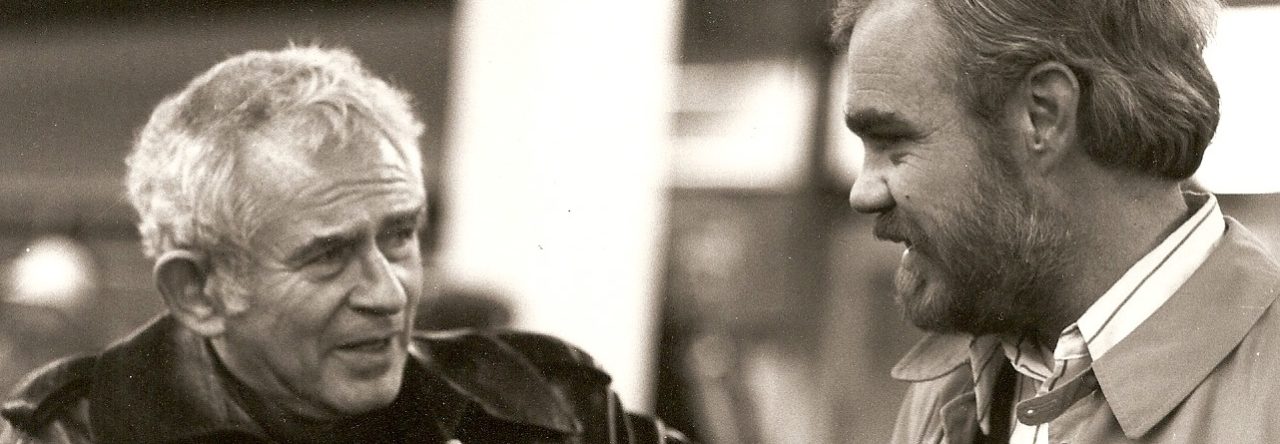
J. Michael Lennon . . . challenges Mailer obsessives to wade through 960 pages of “Norman Mailer: A Double Life,” as if it were not enough to have finished all 1,136 pages of “The Executioner’s Song,” Mailer’s Manhattan-phone-book-size Pulitzer winner, from 1979.
Author: webmaster Page 20 of 36
Heroically brave and mad, prodigious in his industry and appetites, Norman Mailer was an altogether excessive figure. Since his death in 2007 there have been several biographies, but this is the big one — big enough to accommodate a triple or quadruple life, let alone a double. It is also the official one, written at Mailer’s request by J. Michael Lennon, his friend, collaborator and literary executor, who is respectful and affectionate but not hagiographic.
The book is fascinating throughout. All readers will benefit from Lennon’s treatment of Mailer’s writing process, his compulsive philandering, his often crass self-promotion, his unexpected discipline, his capacity for violence, his attraction to and sympathy for criminals, his relationships with his many children and his peers, and his risk-taking in all areas of life and art.
Charles Webster Hawthorne built the barn in 1907 atop a sandy bluff in Provincetown at the tip of Cape Cod. He opened it as an art school. . . . In time, however, the school closed. And as the decades passed, the barn became less an incubator of art than an object of art itself. Dozens of prominent artists and writers studied or otherwise spent time in the barn. The list includes Norman Rockwell and Jackson Pollock, Tennessee Williams and Norman Mailer. Little surprise then that in 1979, the barn joined the National Register of Historical Places.
Instead of merely continuing Lucid’s work, Lennon began anew and very much made it his own. At times, he’s too willing to give his pages over to Mailer admirers (Mailer included) to embroider testimonials to his greatness. But in the main Lennon has done a very fine job of chronicling most every possible dimension of a sprawling, brawling, daredevil-cum-car wreck of a singularly great American writer’s life – and I can say that without fear of a 150,000-word letter to the editor disputing everything I’ve just written, save that Norman Mailer was great.
Not only is Norman Mailer’s Oswald’s Tale the first mentioned, but Mike is quoted:
Mailer disappointed numerous conspiracy theorists by coming to the conclusion that, as Mailer’s biographer J. Michael Lennon put it, Mailer chose “no conspiracy, and a complex Oswald; a man dealt a bad hand, in no way heroic, but bold, idealistic in a twisted way, and sympathetic.”
Norman Mailer is like America. Loud and colorful, sometimes brilliant, at times mediocre or worse, often the victim of his own self-regard, and willing to die trying for the right cause.
James Wolcott mentions Mike’s interview with Donald K. Fried in The Daily Beast.
How do you tell the story of one of the 20th century’s larger-than-life literary figures? Norman Mailer’s latest biographer J. Michael Lennon talks literary reputation, omens, women, and the never written.