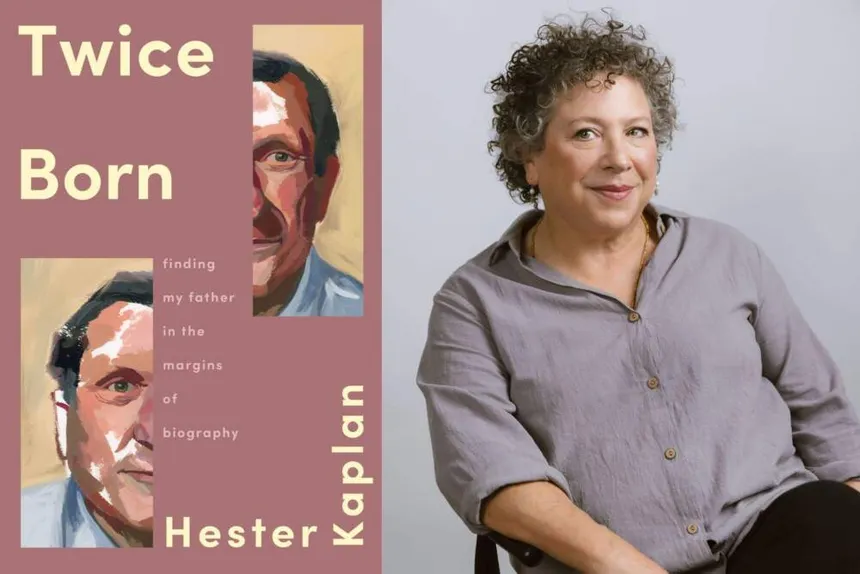
Review of Twice-Born: Finding My Father in the Margins of Biography
By Hester Kaplan | Catapult, 2025, $27
Hester Kaplan’s book is a generic puzzler: should it be shelved with biography, literary criticism, or autobiography? It’s about half of each. But it’s also a life-and-times account with wedges of social history. If it eludes categories, it is because the author’s motives are complex. She carefully unravels the tangle of talent, research, guilt, grit, and circumstance that resulted in Mr. Clemens and Mark Twain (1966) by her father, Justin Kaplan, who died in 2014. She also presents a privileged point of view on his education, family, residences, finances, Jewishness, and his and his novelist wife Anne Bernays’s place at the top of the artistic and professional community of Cambridge, Massachusetts. They were also presences on Cape Cod, and spent summers in Truro for decades. Their daughter’s book focuses on his profound identification with Mark Twain, but also depicts his successful marriage to a successful novelist, his oblique relationships with his three daughters (same number as Twain), and his agonizing and recalcitrant eczema that is the sign and symbol of the seven-year struggle to write his canonical biography, winner of the National Book Award and a Pulitzer. Undergirding everything is her scrupulous depiction of her father’s unabated ambition, one which mirrors Twain’s, and also her own. His ambition was to reanimate Twain, to become his incarnation. It took a toll. Hester states that he was more “fully engaged” with Twain’s daughters than he was with his own.
At the age of 33, after college and several years as a freelance writer, and then several more as a valued but distracted editor at Simon and Schuster, Kaplan resigned, moved to Cambridge, Massachusetts and began working on a biography of Twain, who published his first best-seller, The Innocents Abroad in 1869 at the same age. Kaplan called Twain “the most richly endowed natural talent in American history,” and the urgent desire to write his biography was buttressed by the fact that he, like Twain, had lost his father at an early age, and also tried different occupations for more than a decade before firmly choosing a writer’s life. He sensed—again, like Twain—that the disappointments and losses of his early years growing up in New York City might be the foundation to the creation of a new identity. As his daughter shrewdly observes, her father “imagined, as Twain had, the possibility that his own history, might direct rather than stymy his future, its energy of loss and survival converted into insight. He felt the thrill of his own possible hatching as he read about Sam Clemens becoming Mark Twain.”
Hester Kaplan’s book also has some kinship with a Henry James novel, in that it seeks to present the drama of complex, roiled inner lives, And like James in his 1886 novel, The Bostonians, she gives us a portrait of the hothouse of camaraderie, snobbery, and genius that Boston/Cambridge has been for two centuries of American life. Over one corner of the Kaplans’ backyard fence on Francis Street was the former home of William James, over another was that of Julia Child, and not far away the house where e.e. cummings was born. John Kenneth Galbraith lived a few houses down the street, and like Arthur Schlesinger, Jr., became a close friend. Justin made big pots of chili for his party guests, including Seamus Heaney, Jessica Mitford, John Irving, Annie Dillard, Edward Albee, Bella Abzug, Robert Stone, and Tim O’Brien. Kurt Vonnegut spent a night on the living room couch.
The house on Francis Steet is the mise-en-scène of her book.She takes us into his off-limits study, as “unreachable as the moon,” noting his memorabilia, paper weights, golden pencil, and photographs, including a Matthew Brady portrait of eleven-year old Henry James with his father. These talismanic objects bolstered his sanction to write almost every day for decades. She also provides several sharp recollections of the agony and ecstasy of composition, and the entwined psychological and physical suffering it entailed. One of her shrewdest tactics is to use as a touchstone her father’s perfidious skin condition. He had an extreme case of atopic dermatitis, or eczema, caused by to some extent by genetics and environmental issues, and magnified by stress. He scratched himself until he bled, and in one miserable period of anxiety about his biography’s reception, was hospitalized. His itchiness intensified whenever “he got into the ring with his heavily muscled doubts,” which was half the time. One of the worst periods was when he was reading the book’s galley proofs—often a time of agonizing reappraisal for a writer—and was assailed by doubts after reading something he’d written about Twain drinking tea under some olive trees and watching the sun set over the hills of Florence:
Experience ricocheted between him and his subject as he assumed the same posture, looking for his ease. But at the end of the day he was drawn and unsmiling, sensitive to light and our noise, sober with anxiety despite his gin and tonics, and he couldn’t help remembering other, darker views. He scratched nonstop between his fingers, up and down his forearms, his cheeks, his legs, the back of his neck, his skin becoming increasingly inflamed and fissured and dotted with scabs.
She writes that “my father recognized in Twain a fellow lifelong guilt seeker . . . who never found out why he was accusing himself.” Both sometimes felt, without apparent justification, unworthy not only of surviving, but thriving.
Kaplan’s daughter, like him, places an extraordinary emphasis remembering, relishing, and anatomizing key traumatic moments. In a key section about halfway through she relates how she was sexually assaulted not long after high school, and links the trauma of that event to Edmund Dantes’s escape from the prison on the Île d’If in the Marseille harbor in Alexandre Dumas’s The Count of Monte Cristo. Her father gave her the novel shortly before the assault, and she explains how his transformation at 33 into a full-time writer mirrors, and was inspired by, the daring of Dantes. Ashore, he creates a new name, a title, and control over his destiny. His story became emblematic for father and daughter. Her retelling of the rebirth scene in Dumas’s novel made me recall my own moment in the Harbor of Marseille. I was on bridge watch as a junior naval officer when my ship steamed into Marseille Harbor in the mid-1960s. When I saw the name Île d’If on the navigation chart, I shouted out “Monte Cristo” two or three times to the puzzled bridge watch. As we passed under the castle’s turrets on our way to moorage a mile further in the harbor, I gave a breathless summary to the ship’s navigator about the island, the castle, Dumas’s novel, and Dante cutting himself out of a burlap burial sack as it sank to the harbor floor. No one aboard, save one friend later on, really understood what had excited me, but it was, like that of Hester and Justin Kaplan, a valuable handhold for me on my own journey to becoming as biographer.