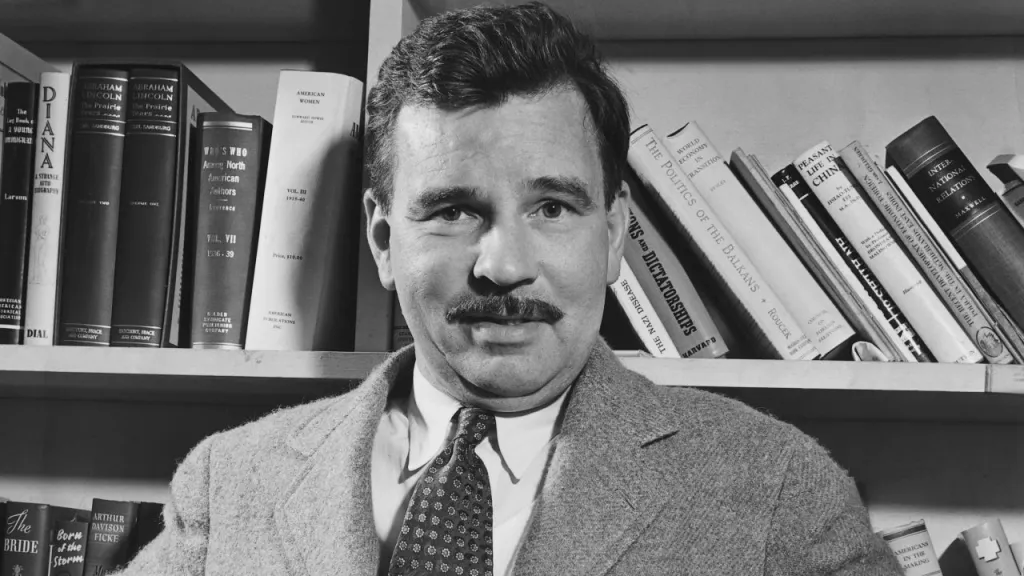
A portrait of Malcolm Cowley and his famous authors
Gerald Howard’s The Insider is a crowded but colourful portrait of Malcolm Cowley, poet, editor and chronicler of the so-called Lost Generation – those American exemplars of literary modernism who, like Cowley, lived in Europe after the First World War, and fill out his memoir of the period, Exile’s Return (1934). Cowley edited the New Republic from 1929 to 1944 and founded the League of American Writers in 1935, but ran afoul of the House Un-American Activities Committee in 1942. After the war, Cowley became an editor at Viking Press, the chancellor of the American Academy of Arts and Letters, and a professor of creative writing at Stanford University, all while contributing a slew of essays and articles to the New Yorker, the Atlantic, the New Republic and many other journals.
Some of Cowley’s best essays of the 1930s and 40s were reassessments of William Faulkner and Ernest Hemingway. Two Viking Press anthologies followed, both of which he edited: The Portable Hemingway in 1944, and The Portable Faulkner in 1946. The first strengthened Hemingway’s claim to a place in the American pantheon, and the second revived the reputation of Faulkner, most of whose books were then out of print. At Stanford, Cowley developed into an astute talent scout. His students included Robert Stone, Ernest Gaines, Tillie Olsen, Larry McMurtry, Wendell Berry, Peter Beagle and Ken Kesey. In 1962, Viking published (with editorial help from Cowley) Kesey’s One Flew Over the Cuckoo’s Nest, and in 1968 Beagle’s classic fantasy, The Last Unicorn.
Jack Kerouac published On the Road in 1957. For six years before that, Cowley worked patiently with the disheartened author, cheering him on, finding financial support, and revising the manuscript, typed on a 120-foot roll of tracing paper. Together, Cowley and Sterling Lord, Kerouac’s agent, championed the novel as the defining text of the Beat Generation. In the 1930s,Cowley boosted the career of John Cheever by publishing several of his short stories in the New Republic. He did the same in 1951 for the nearly forgotten F. Scott Fitzgerald by editing The Short Stories of F. Scott Fitzgerald. He also helped younger critics such as Mary McCarthy, Lionel Trilling and Alfred Kazin by giving them reviewing assignments early in their careers.
But Cowley first played the role of literary godfather to the expatriate writers of the 1920s and might fairly be called their Boswell. His memoir in part an account of the author’s time spent driving an ambulance during the First World War, but Exile’s Return is also a depiction of life in Paris after the war, with a series of vivid portraits of James Joyce, Marcel Proust, Ezra Pound, Hemingway, John Dos Passos, Fitzgerald, E. E. Cummings, Paul Valéry, Tristan Tzara (the founder of the Dada movement) and Gertrude Stein, “the doyenne of exiles”. The book also lays out with clarity the four stages of American exile, as Cowley conceived of them. They were: alienation from philistine nativism and commercialism; disillusionment and radicalization caused by war; the flight to postwar Europe (Paris especially); reintegration in the US by the end of the decade. It is usually judged to be Cowley’s finest work.
Exile’s Return also profiles the poet Hart Crane. Cowley and he were close friends in the 1920s, and Crane helped Cowley assemble his first book of poems, Blue Juniata (1929). His portrait of Crane, including commentary on his long, dithyrambic poem, The Bridge (1930), celebrating the Brooklyn Bridge as the key symbol of American identity, contains a memorable description of Crane’s compositional process:
Hart – we sometimes called him the Roaring Boy – would laugh twice as hard as the rest of us and drink at least twice as much hard cider, while contributing more than his share of crazy metaphors and overblown epithets. Gradually he would fall silent, and a little later he disappeared. In lulls that began to interrupt the laughter, now Hart was gone, we would hear a new hubbub through the walls of his room – the phonograph playing a Cuban rumba, the typewriter clacking simultaneously; then the phonograph would run down and the typewriter stop while Hart changed the record, perhaps to a torch song, perhaps to Ravel’s “Bolero”. … An hour later he would appear … his face brick-red, his eyes burning, his already iron-gray hair bristling straight up from his skull … In his hands would be two or three sheets of typewritten manuscript, with words crossed out and new lines scrawled in. “R-read that”, he would say. “Isn’t that the grreatest poem ever written?”
Cowley’s authorized biographer, Hans Bak, called him “the middleman of American letters”. It is a more apt description than Howard’s “insider”, given Cowley’s tireless efforts to introduce new writers to publishers and the reading public, while acting as cheerleader for a revised American canon. That career began in January 1919 with a review in the New Republic and ended in May 1985 with a last column in the New York Times Magazine. From 1920 to 1973 he edited or wrote more than twenty books, 337 essays and 542 reviews. Cowley described those reviews as an art form “that became my blank-verse meditation, my sonnet sequence, my letter to distant friends, my private journals”. When he died in 1989 at the age of ninety, he’d published well over 1,200 magazine and journal pieces.
Howard’s early chapters cover Cowley’s youth in rural Pennsylvania, his Harvard years, his stint as an ambulance driver, and the postwar years up to 1930 (including two in France, 1921–23). They read briskly. But the middle of the book is inflated with an overly detailed account of Cowley’s admiration for socialism and Soviet communism in the 1920s, the beating he took in the 30s and 40s from anti-Stalinist intellectuals on one side, and Trotskyists on the other, and his eventual recantation during the Red Scare of the 1950s. Howard also devotes a good deal of space – but more profitably – to Cowley’s role in the growing magazine industry in America, and the founding of the Viking Portable Library.
By the early 1940s Cowley had become something more than a fine critic and helpful editor. Howard calls his subject a “great Americanist”, but he doesn’t see that greatness as a cumulative achievement, a product of industry. Rather, he attributes it to a large extent to Cowley’s understanding of the central importance of Edgar Allen Poe. Two essays in particular, “Poe in Mississippi” (New Republic, 1936) and “Hemingway at Midnight” (New Republic, 1944), showed how the submerged traumas and nightmarish settings of Poe’s work had been adapted by Faulkner and Hemingway. In the 1944 essay he argues that Hemingway was inspired by Poe, Nathaniel Hawthorne, and Herman Melville, “the haunted and nocturnal writers, the men who dealt in images that were symbols of an inner world”. Cowley’s insights challenged the dominant notion that Faulkner was a mere local colourist, and Hemingway primarily a realist in his early stories, especially “Big Two-Hearted River”.
Cowley’s appreciation of Poe was enhanced by the time he’d spent in Paris. French writers – Charles Baudelaire, Stéphane Mallarmé, and Paul Valéry – revered Poe for his hidden meanings, the application of what Hemingway later called “the iceberg principle”. And Gerald Howard’s restatement of Poe’s appeal beautifully captures the spirit of what it was about him that so moved Hemingway and Faulker. Poe succeeded, he writes, “in combining old elements so as to form a new world stamped with his own personality, a region out of space and out of time, where the House of Usher crumbles eternally behind a stagnant moat, where Arthur Gordon Pym drifts southward towards the pole, where ravens tap in the night against a lattice, and where Eleonora gathers ever-lasting flowers that carpet the Many-colored grass”.